
Fill all information details to consult with us to get services from us
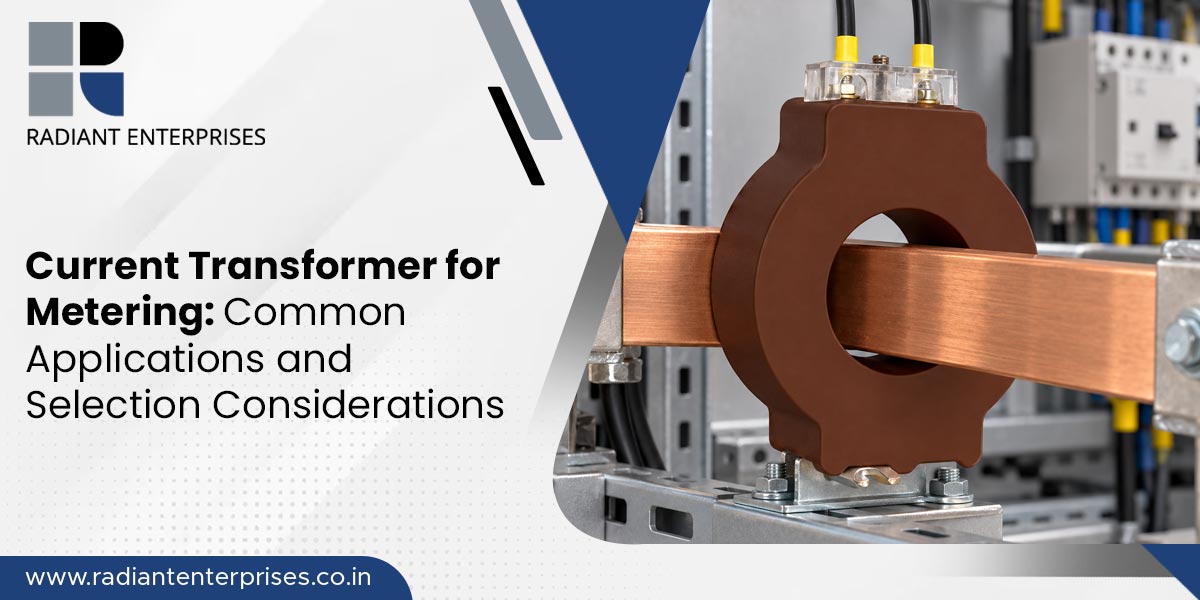
You open an energy report, and the figures don’t match what you expected from the month’s work. Before you question every machine or shift, we suggest checking how current reaches your meter. At Radiant Enterprises, we understand how much uncertainty can sit behind one doubtful reading. As a Current transformer manufacturer in India, we believe dependable measurement starts with understanding your actual load.
Perhaps you’re planning a new panel rather than checking an existing meter. You still face the same concern: choosing equipment you can trust once production begins. We want to make that choice clearer, without burying you in terms that need another explanation.
A meter shows a number, but that number depends on the full measuring circuit. We use a current transformer, or CT, to turn high alternating current into a smaller, proportional signal. The meter receives this signal through the secondary circuit, with electrical separation from the primary conductor.
When we discuss a Current transformer for metering, we start with what you need to measure. Are you checking one feeder, comparing production lines, or recording energy for billing? Your answer helps us focus on the accuracy, current range, and physical arrangement that matter.
We also keep expectations clear. A CT alone cannot explain a high bill or locate wasted energy. We need to consider meter settings, wiring, operating hours, and actual consumption before drawing conclusions.
At Radiant Enterprises, we approach each measuring point by asking what decision the reading needs to support. A main incomer gives you a broad view of demand. A feeder meter brings that view closer to a machine group, floor, or process.
As a Current transformer supplier in India, we help you consider several common uses:
These uses often overlap. You might begin with a simple load check and later need clearer cost records. We encourage you to share that possibility early, so the specification reflects your plans.
It’s tempting to choose a higher ratio to leave plenty of room for future growth. We understand the reasoning. Nobody wants to replace equipment soon after fitting it. However, an oversized ratio can place normal operation in a less suitable part of the measuring range.
As a Current transformer manufacturer in India, we consider expected running current alongside the highest current you need to measure. For example, a 400/5 A ratio means 400 A primary current corresponds to 5 A secondary current under rated conditions. We also check lighter loads rather than judging suitability from peak demand alone.
At Radiant Enterprises, we want your expected working range to guide the choice. We check that the secondary output matches the meter input, commonly 1 A or 5 A. We also confirm that the meter’s programmed ratio matches the installed CT.
An accuracy class tells us about permitted errors under stated conditions. It does not promise the same performance at every current and connected load. We therefore review the class together with the expected operating range and measuring circuit.
As a Current transformer supplier in India, we ask whether your readings support routine monitoring or formal billing. We check the applicable project or utility requirements before agreeing on a class. We also keep metering and protection duties distinct, since a protection core is not automatically suitable for accurate energy measurement.
- Remember the cable between the CT and meter:
We use the term burden for the load placed on the CT secondary circuit. This includes the connected meter and losses in the wiring. Cable length and conductor size therefore matter, even when the meter itself draws little power.
At Radiant Enterprises, we assess the complete secondary circuit against the CT’s declared accuracy and burden conditions. We don’t assume a larger VA rating will always improve measurement. The aim is a suitable match between the CT, cable, and meter.
A sound electrical specification can still cause trouble if the CT does not fit. We know how frustrating late drawing changes can be when a panel is nearly complete. Checking dimensions early gives you room to resolve small clashes before assembly.
As a Custom current transformer solutions provider in India, we review the conductor arrangement, mounting space, and terminal access. We also consider cable or busbar dimensions, clearances, and the location of nearby components. A drawing often reveals a practical concern that a rating list misses.
We bring insulation requirements into the same discussion. As a Resin cast current transformer supplier in India, we check the specified voltage, service conditions, and enclosure arrangement. Resin casting does not remove the need to confirm temperature limits, moisture exposure, or indoor and outdoor suitability.
At Radiant Enterprises, we would rather clarify an uncertain detail than let it become a site problem. You don’t need a perfect brief to begin the conversation. A clear outline of the duty helps us identify what still needs checking.
As a Custom current transformer solutions provider in India, we ask you to bring these details together:
As a Resin cast current transformer exporter in India, we also ask about destination requirements before supply. Clear agreement on ratings, documents, and packing helps you avoid preventable questions during receipt and installation.
We treat installation as part of dependable measurement. Polarity, phase connections, terminal identification, and meter settings all need checking. Even suitable equipment can produce misleading readings when a connection or setting is wrong.
At Radiant Enterprises, we stress one essential precaution: never leave a conventional CT secondary open while primary current flows. Dangerous voltage can develop across the open terminals. We advise qualified personnel to follow the approved isolation and shorting procedure before disconnecting the meter.
As a Resin cast current transformer supplier in India, we encourage checks against approved drawings before energising the circuit. We also recommend recording initial readings against known operating conditions. This gives you a useful starting point for later checks.
As a Resin cast current transformer exporter in India, we value clear handover information alongside the supplied equipment. With Radiant Enterprises, we invite you to start with your load details, meter requirements, and panel layout. Together, we can turn a confusing specification into a clear, practical purchasing decision.
We use a current transformer to reduce high alternating current to a proportional signal. This allows compatible meters to measure loads beyond direct connection limits.
We use metering CTs in factory feeders, commercial buildings, distribution panels, and energy monitoring systems. Each measuring point helps you understand how electrical loads change.
We match the CT ratio to your expected operating range and maximum measured current. Choosing an oversized ratio can reduce accuracy during lighter loads.
We select the accuracy class against your utility’s billing requirements and the applicable standard. We also check performance across the expected current and burden ranges.
We match the secondary output to your meter input. For longer cable runs, a compatible 1 A system reduces wiring losses compared with 5 A.
Yes. Longer secondary cables increase resistance and burden, which can affect accuracy. We check cable length, conductor size, and meter load before confirming CT suitability.
We check CT polarity, phase connections, and programmed ratios first. Wiring errors can cause misleading readings, although negative power can also indicate genuine energy export.
We only use a protection CT for metering when its declared metering accuracy meets your needs. A protection rating alone does not establish measurement accuracy.
Never open a conventional CT secondary while primary current flows. We require qualified personnel to follow approved isolation and shorting procedures before disconnecting metering equipment.
We confirm outdoor suitability from the product’s declared ratings and service conditions. Resin casting alone does not establish resistance to weather, sunlight, or moisture exposure.
We first check secondary output, ratio, accuracy, and burden compatibility. You can retain an existing CT when its condition and ratings meet the new requirements.
At Radiant Enterprises, we ask for current range, voltage, frequency, meter details, accuracy needs, cable length, and mounting drawings. These details help us assess suitability.